Live tail
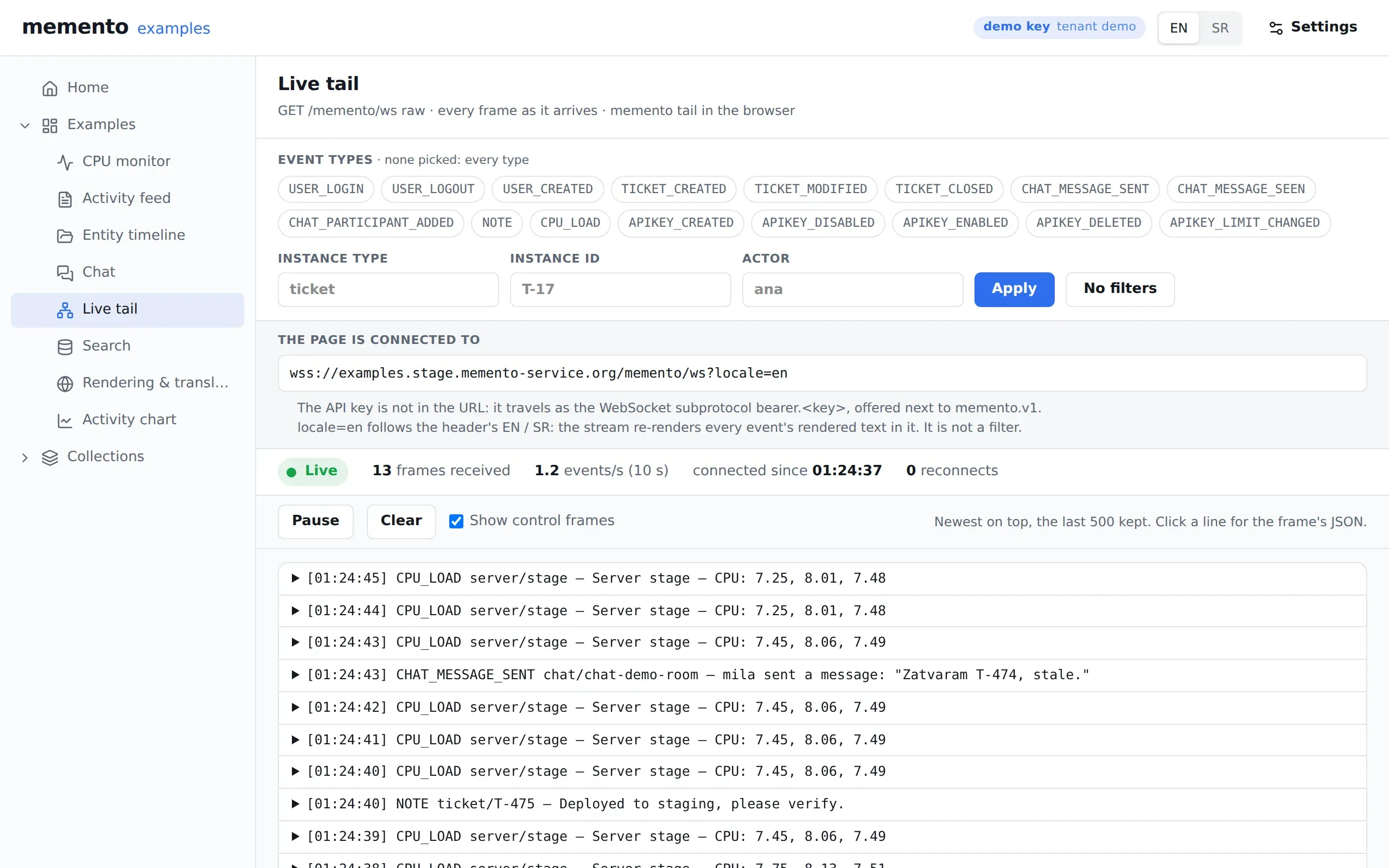
memento tail in the browser. The page opens GET /memento/ws and lists every frame the socket
delivers, as it arrives. This is not a UDC list but the stream itself, to see how it works;
nothing on the page is persisted. The protocol: Streaming and
its reference.
memento simulate / cpu-monitor ──POST /events──▶ memento ──ws /memento/ws?event_type=…&locale=en──▶ /examples/tail ◀── memento.ping (every heartbeat) ─────── MementoStream ──── memento.welcome · memento.event.new · memento.pong ──▶The stream’s own client
Section titled “The stream’s own client”MementoStream from @jsmemento/core connects — the key as the subprotocol bearer.<key> next to
memento.v1, never in the URL — waits for the welcome and reconnects with backoff. The page
hands it a WebSocket that listens in on the socket it opens, so it sees the raw text of every
frame, not only the events MementoStream passes on. Two frames as the stream sends them, a
welcome and an event:
{  "kind": "memento.welcome",  "payload": {    "protocol_version": "1",    "tenant": "t-4uvljqyl",    "filter": { "instance_type": "user", "instance_id": "42" },    "heartbeat_interval_ms": 30000,    "max_buffered_messages": 1000  }}
{  "kind": "memento.event.new",  "id": "0cba06fc…",  "payload": {    "id": "0cba06fc…",    "occurred_at": "2026-11-02T00:41:20.166Z",    "received_at": "2026-11-02T00:41:20.169Z",    "event_type": "USER_LOGIN",    "instance_type": "user",    "instance_id": "42",    "actor_id": "igor",    "payload": { "client": "web", "method": "password" },    "rendered": "User igor logged in.",    "rendered_locale": "en",    "archived_at": null,    "api_key_id": "44cebcf6…"  }}
Filters
Section titled “Filters”The filter bar is the stream’s filters: event types as a multi-select of memento’s vocabulary
(EVENT_TYPES, from lookups.yaml), instance type, instance id and actor as text (Enter or
Apply). They live in the page’s URL (?event_type=TICKET_CREATED&instance_id=T-3), so a
link reproduces them. A stream’s filters are fixed for the life of a connection, so every change
is a new connection and a fresh list. The ws://…/memento/ws?… URL the socket opened is shown
verbatim, to copy.
- The stream takes one
event_type. With several picked the URL has none, every type arrives, and the page keeps the picked ones itself; the others are counted as left out by the page. - A filter the server would refuse with
422before the upgrade (for exampleinstance_type=Ticket) is not connected; the page says why. localeis a parameter, not a filter: the page connects with?locale=enorsr, sorenderedarrives in the header’s language. Switching EN / SR reconnects.
Frames
Section titled “Frames”Newest on top, the last 500 kept. Each row is the one-line summary of memento tail —
[hh:mm:ss] EVENT_TYPE instance/id — rendered — and opens to the frame’s pretty-printed JSON.
What is not an event is dimmed and can be hidden (Show control frames): memento.welcome
(tenant, filter, heartbeat), memento.pong, memento.error, and the socket closing with its
code and reason, which is not a frame on the wire.
The server’s WebSocket pings are answered by the browser without the page seeing them, so the
page sends the stream’s own memento.ping at the welcome’s heartbeat_interval_ms, and each
memento.pong is a row.
Pause keeps receiving and shows N new while paused; Resume puts them on top; Clear empties the list. The counters: frames received, events per second over the last 10 s, connected since, reconnects. The status dot is amber while connecting, green when live, red when closed, with the close code and reason (Closed 4008 slow consumer).
The page: apps/examples/src/examples/tail/.
The same from a terminal: memento tail in the CLI reference.
v1.1.0released built 663143e