Entity timeline
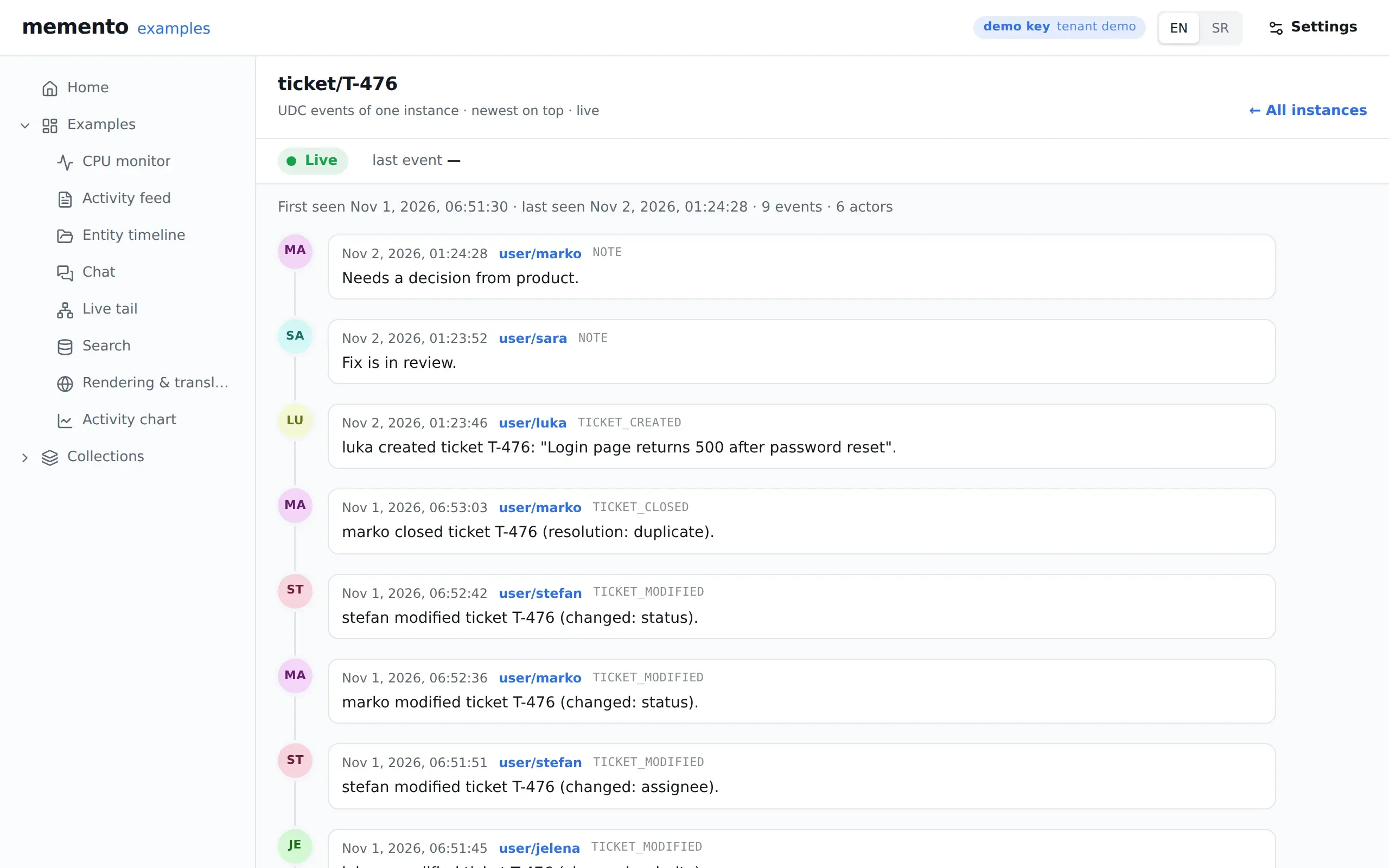
memento’s central question — what happened to this object? — for one instance. Pick
ticket/T-3 and read its story: created, modified, noted, closed, newest on top, live. Every
event is tied to an instance (instance_type and instance_id); this page is that idea on
screen (Events and instances).
/examples/entity picker: the tenant's instance types, the latest instances │ click / type an id of the chosen one, with their event counts ▼/examples/entity/ticket/T-3 ──POST /udc/list {collection: events,──▶ memento filter: instance_type = ticket AND instance_id = T-3} ◀──ws /memento/ws?instance_type=ticket&instance_id=T-3── refetchThe timeline
Section titled “The timeline”/examples/entity/:instance_type/:instance_id shows the same events as
GET /memento/entities/:instance_type/:instance_id/events, read through UDC like every list of
the site: the events collection with an exact and of instance_type eq and
instance_id eq, sorted occurred_at desc, 50 rows a page with Older events. The rows come
through useUdcCollection of @jsudc/react; there is no new endpoint and no hand-written
fetch.
Each entry has the date and time, the actor’s avatar, the event type as a tag and the text
memento rendered in the header’s language (EN / SR, as in the feed).
On top, a summary: first seen, last seen, the event count (the list’s total) and the distinct
actors. While older pages are not loaded, the first event comes from its own one-row ascending
list.
Every actor of an entry is an instance too, user/<actor>, and links to its own timeline. The
routes are react-router’s, so the browser’s back button walks the way back.
The picker
Section titled “The picker”/examples/entity lists the tenant’s instance types, which are not a fixed list. UDC has no
distinct, so the page walks them with one-row lists (instance_type gt <previous>, sorted
ascending): exact, and a handful of requests for the few types a tenant has, at most 50. It
opens on ticket when there is one, and ?type= keeps the choice.
For the chosen type, the latest 200 events give the 12 most recently active ids, each with its
last activity and its event count — the exact total of a one-row list of its events. Or
type one: any type and id by hand.
useLive (from @jsmemento/ui-shell) subscribes to the stream filtered by the open instance,
/memento/ws?instance_type=ticket&instance_id=T-3; every event refetches the timeline, at most
once per 250 ms. New entries fade in. An instance with no events says so and links back to the
picker on its type.
The page: apps/examples/src/examples/entity/.
v1.1.0released built 663143e