Search
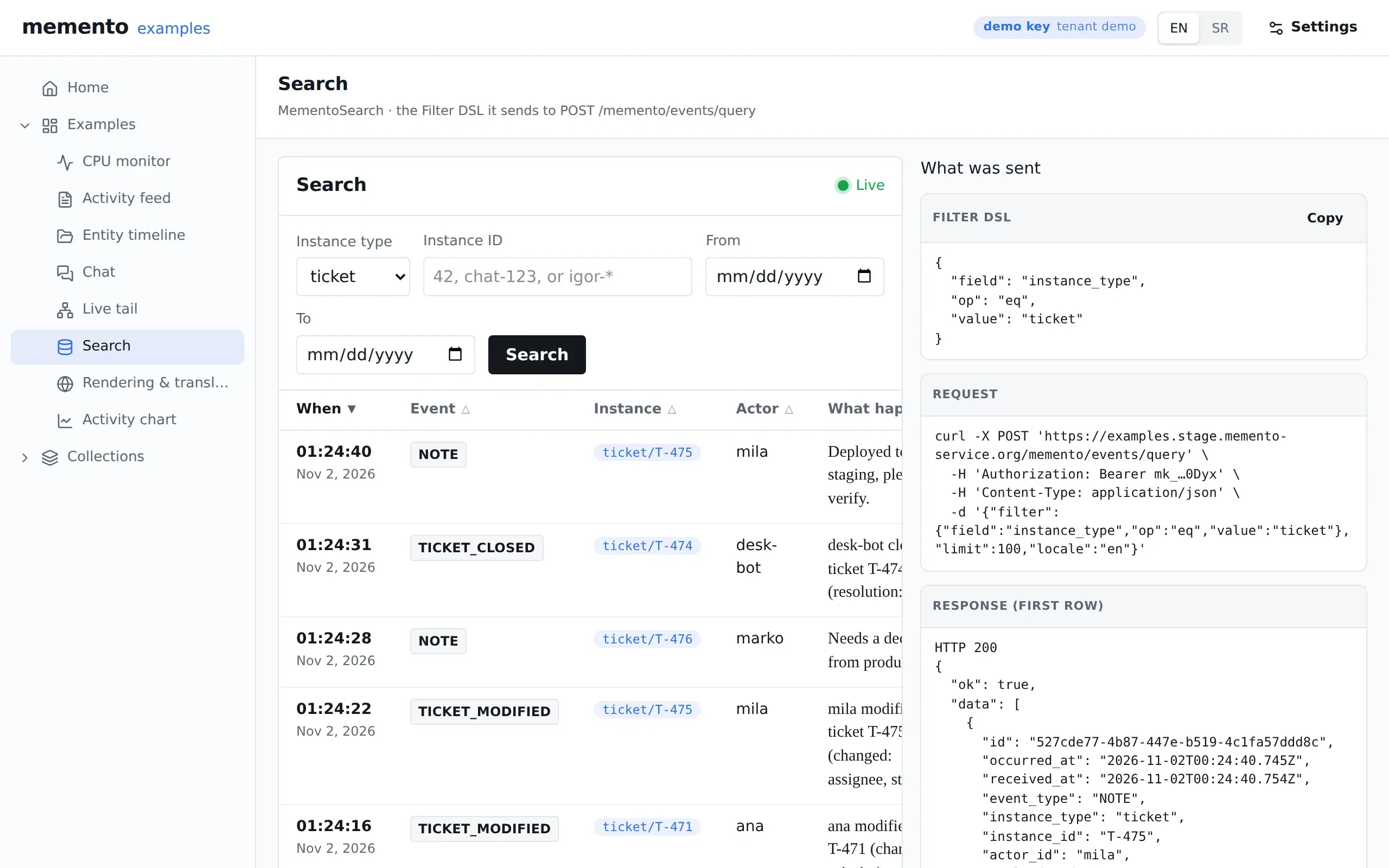
How a search is expressed. On the left, MementoSearch from @jsmemento/react; on the right,
under What was sent, the request it made — read off the wire, not rebuilt.
MementoSearch ──POST /memento/events/query {filter: <Filter DSL>, limit: 100, locale: en|sr}──▶ memento (type, id, from, to) ◀── {ok, data: [events, newest first], meta} ────────────────────────── │ the same tree, UDC's op names ▼/udc/events?f=<encodeFilterParam(tree)> ──POST /memento/udc/list {collection: events, filter}──▶ mementoThe form is the component’s
Section titled “The form is the component’s”Instance type, instance id (exact, or a prefix with *: T-1*), and a from / to day range
(to inclusive). MementoSearch turns them into a Filter DSL tree — eq or prefix per field,
occurred_at gte the first day and lt the day after the last — and sends it to
POST /memento/events/query. The results are its table; the Instance cell is a chip that opens
the instance’s timeline. While the range has no end, the results stay live
on the stream. The DSL itself: Filter DSL.
What was sent
Section titled “What was sent”The page gives MementoProvider a fetch that lets every request through and reports each
POST …/events/query. Three read-only panes follow every search:
- the Filter DSL JSON of the body, with Copy (
nullwhen the search filters on nothing); - the request as a
curlcommand against the absolute URL, the key masked (mk_…9f3a); - the response: HTTP status,
ok,meta(memento’s list envelope hascountandnext_cursor, nototal) and the first row, the rest counted (… 29 more).
The same filter in UDC
Section titled “The same filter in UDC”The events UDC collection takes the same tree in POST /memento/udc/list — conditions of
field, op and value under and, or and not — with three operators spelled UDC’s way:
prefix is starts_with, ne is neq, nin is not_in, and is_null: false is
is_not_null. The translated tree is shown under As a UDC filter. Open in the UDC events
table goes to /udc/events?f=…, the tree encoded with encodeFilterParam of
@jsudc/react/headless, so the table opens with the same conditions as its filter chips.
In the URL, in the header’s language
Section titled “In the URL, in the header’s language”The search is in the URL: ?type=ticket&id=T-1*&from=2026-10-01&to=2026-10-31. A search
always writes type (type= for any type), so a link runs the search on open, and the
browser’s back button restores the previous one, form included.
MementoProvider gets the site’s locale, so the body carries locale: "en" or "sr" and
memento renders rendered in it; switching EN / SR sends the search again.
The page: apps/examples/src/examples/search/.
The route: POST /memento/events/query in the API reference.
v1.1.0released built 663143e