Chat
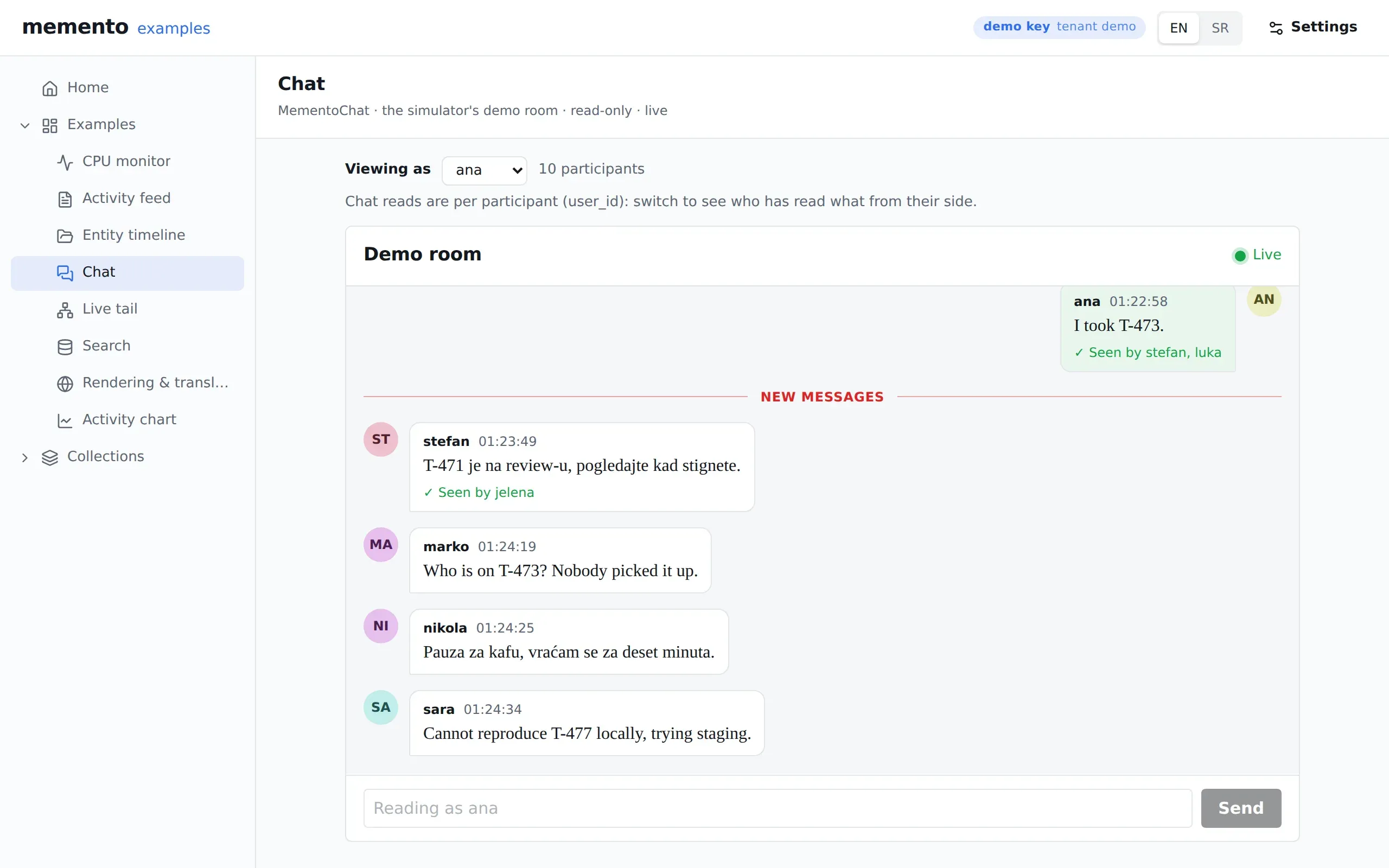
memento simulate also plays a chat: the team talks in one room, and the page shows that room
with MementoChat from @jsmemento/react — the component an application would embed —
read-only and live. A chat is an ordinary memento instance whose messages, read markers and
joins are events (Chats as events).
memento simulate ──POST /chats (once), /chats/chat-demo-room/messages, /seen, /participants──▶ memento │/examples/chat ◀── GET /chats/chat-demo-room?user_id=igor ── participants, read watermarks ──────┤ MementoChat ◀── GET /chats/chat-demo-room/messages?user_id=<viewer>&locale=<en|sr> ───────────┤ ◀── ws /memento/ws?instance_type=chat&instance_id=chat-demo-room ─────────────────┘The room
Section titled “The room”On start the simulator makes sure chat-demo-room (“Demo room”) exists, creating it with igor,
marko, ana and jelena when it is missing. In its chat scene an online member says a short line
about the tickets the desk is working (“I took T-17.”, “Zatvaram T-12, duplicate.”), lines
alternating English and Serbian as people write them — nothing is translated; another member
marks the newest message seen; rarely somebody of the team is added. --no-chat leaves the room
alone.
Read as a participant
Section titled “Read as a participant”Chat reads are made on behalf of a user: memento checks that the user_id of every read is a
participant of the chat. So the page reads the room as one participant, chosen in Viewing
as on top — the first participant by default, kept in the URL (?as=ana). Switching the
viewer reloads the room as that person: their messages are the “own” ones, the Seen by
markers show where the other participants’ read watermarks are, and a New messages
divider shows where the viewer’s unread messages start.
The composer is disabled. With the demo key its tooltip says read-only demo key: that key has
only the read scope, so nothing can be sent and nothing is tried. Writing stays with the
simulator.
Live, without polling
Section titled “Live, without polling”MementoChat loads the newest 100 messages and then follows the room’s events on
/memento/ws: new messages appear as they are sent, read markers move on CHAT_MESSAGE_SEEN,
“X was added” lines appear on CHAT_PARTICIPANT_ADDED. The page follows the same stream
(useLive of @jsmemento/ui-shell) to read the room again when a participant is added, or, while
the room is missing, when it first speaks.
MementoProvider gets the site’s locale: the system lines (“mila was added to the chat” /
“mila je dodat u čat”) are memento’s rendered text and switch with EN / SR; people’s messages
stay as written.
Not UDC, on purpose
Section titled “Not UDC, on purpose”Chats are read through memento’s chat API (GET /memento/chats/:chat_id…), not a UDC
collection: every read is checked against the room’s participants, which the tenant-wide
events collection does not do. The page reads them only through MementoChat and
MementoClient, with no hand-written fetch. The routes: the chats reference.
The page: apps/examples/src/examples/chat/.
v1.1.0released built 663143e