Rendering & translations
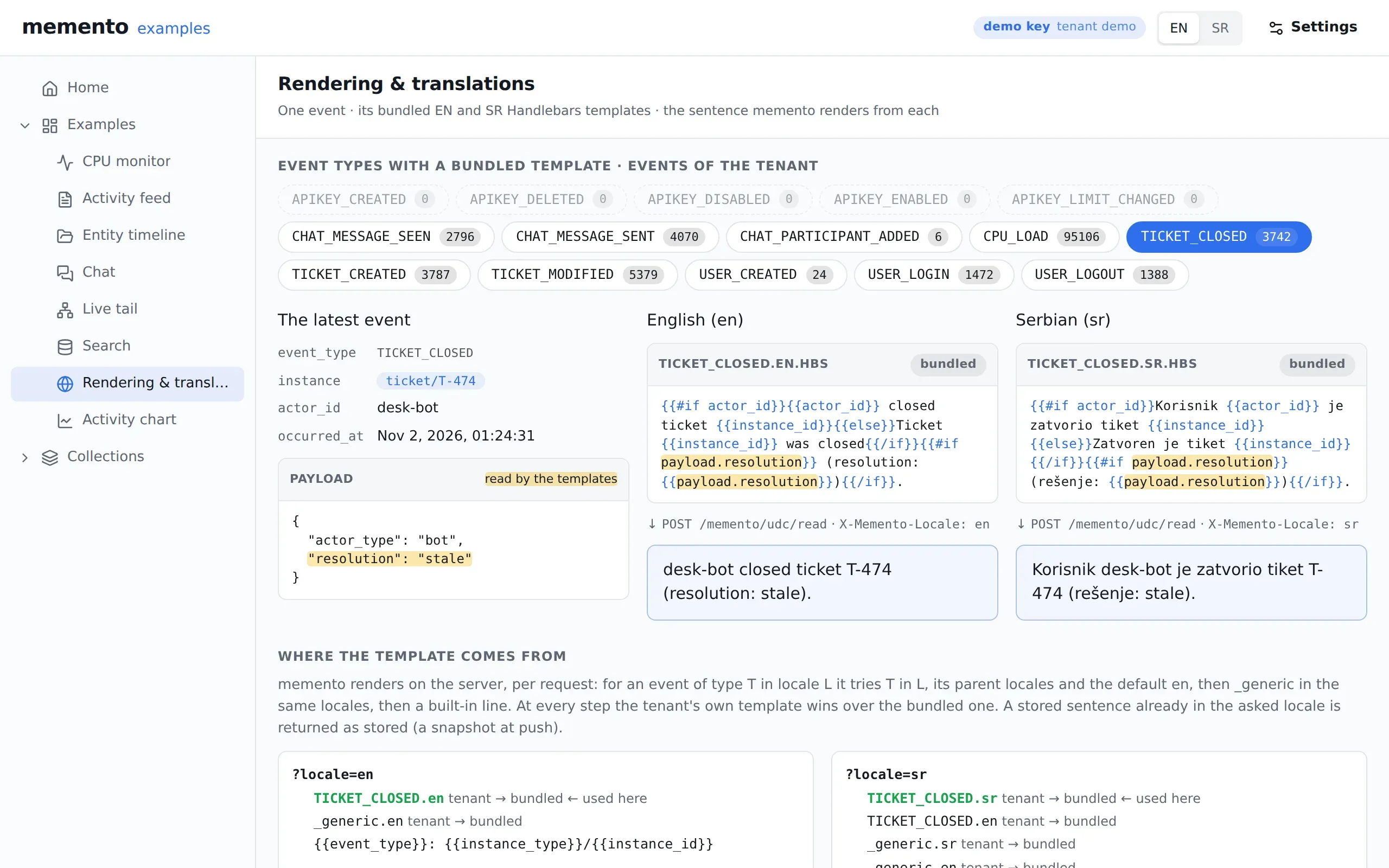
How memento turns an event into a sentence. Pick an event type and the page shows the tenant’s
latest event of it, the bundled .en.hbs and .sr.hbs templates, and the sentence the
server renders from each, side by side. The rules behind it:
Rendering and translations.
packages/server/templates/*.hbs ──import.meta.glob(?raw), at build time──▶ templates.ts (type → {en, sr})/examples/rendering?type=TICKET_CLOSED latest event ──POST /udc/list {collection: events, filter: event_type eq T, limit 1}──▶ memento rendered (en) ──POST /udc/read {collection: events, id} X-Memento-Locale: en ─────────▶ memento rendered (sr) ──POST /udc/read {collection: events, id} X-Memento-Locale: sr ─────────▶ mementoThe templates are the server’s files
Section titled “The templates are the server’s files”The page imports every packages/server/templates/*.hbs with Vite’s import.meta.glob as text
when it is built, and maps them by event type and locale (_generic apart). There is no
endpoint that serves template sources. A tenant’s own template lives in the database
(memento_template) and is not visible here; the page says so and shows the command that would
create one, pnpm memento create-template --tenant <tenant> --event-type T --locale sr --file T.sr.hbs.
The two templates of TICKET_CLOSED, as the page shows them:
{{#if actor_id}}{{actor_id}} closed ticket {{instance_id}}{{else}}Ticket {{instance_id}} was closed{{/if}}{{#if payload.resolution}} (resolution: {{payload.resolution}}){{/if}}.{{#if actor_id}}Korisnik {{actor_id}} je zatvorio tiket {{instance_id}}{{else}}Zatvoren je tiket {{instance_id}}{{/if}}{{#if payload.resolution}} (rešenje: {{payload.resolution}}){{/if}}.Three columns
Section titled “Three columns”- The latest event of the type: its fields, the instance linking to its
timeline, the payload pretty-printed. It is a one-row list of the
eventscollection,event_type eq T, sortedoccurred_at desc. - Per locale, the template and the sentence. The sentences are not a Handlebars run in the
browser: the page reads the same event twice with
POST /udc/read, through twoUdcClients whoseX-Memento-Localeisenandsr. Both are always shown, whatever the header’s language. - Highlighted keys: every
payload.<key>inside a{{…}}of either template — output,#if, a helper’s argument — is marked in the template and in the payload pane, so it is visible which members of the payload the sentence uses.
Under them, where the template comes from: the lookup chain for both locales
(T.sr → T.en → _generic.sr → _generic.en → the built-in line), with the step the bundled files
answer marked; at every step a tenant’s own template beats the bundled one. And _generic: its
EN and SR source and when it is used, for any event type without a template of its own. NOTE
does not go through it: its text is payload.text, stored verbatim, the same in every locale.
The selector
Section titled “The selector”Exactly the types with a bundled template, alphabetical, each with how many events of it the
tenant has (the total of a one-row events list); the empty ones are greyed but still open
their templates. The type is in the URL (?type=), TICKET_CREATED by default.
useLive (from @jsmemento/ui-shell) follows the stream filtered by the picked event_type; a
new event of the type refetches the column and the counts, at most once per 250 ms.
The page: apps/examples/src/examples/rendering/.
v1.1.0released built 663143e